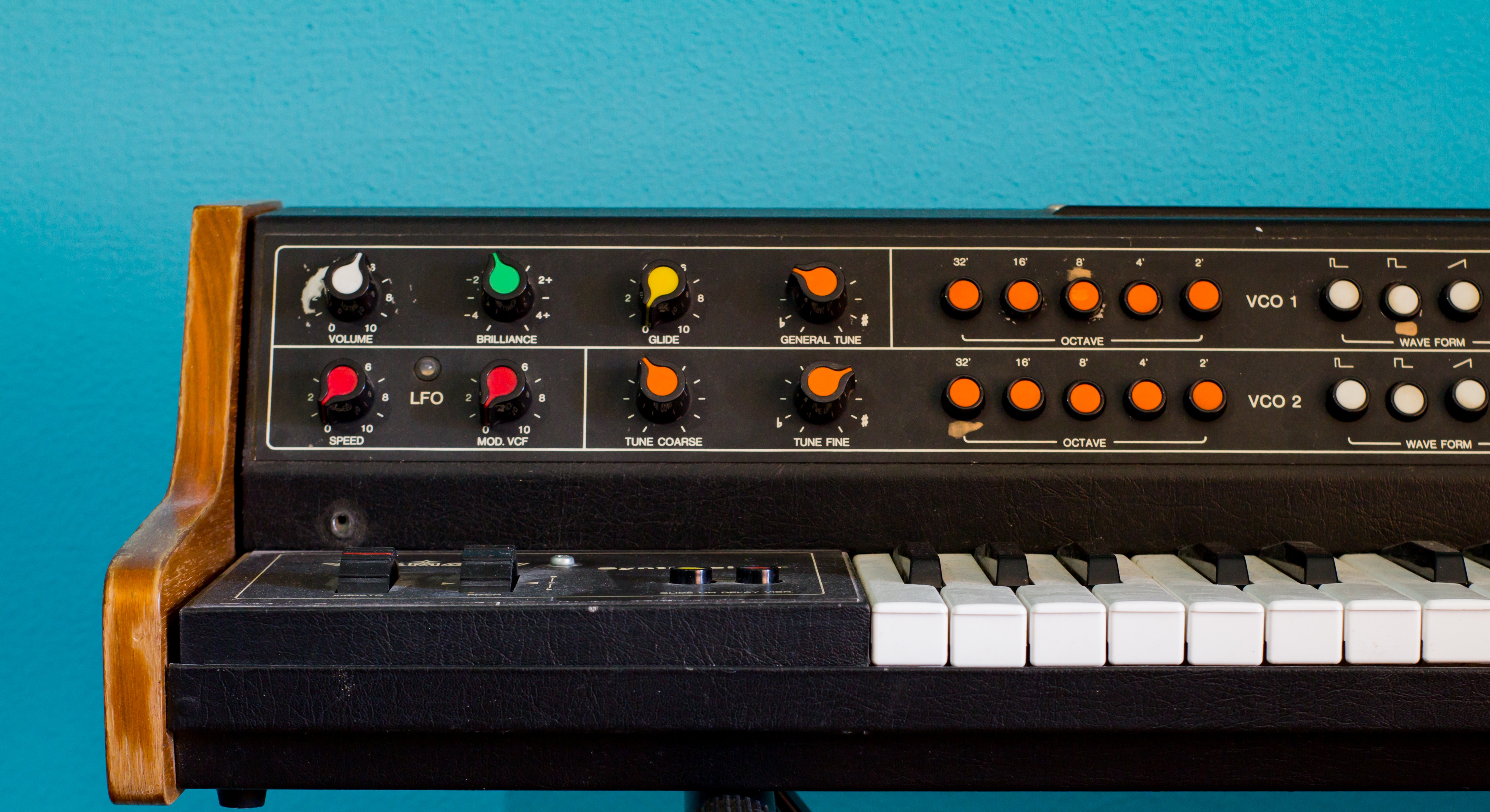
Have you ever played a synth?
This week introduces the fundamentals of synthesizers and subtractive synthesis. We cover history, core components (oscillators, filters, envelopes, LFOs), signal flow, and hands-on patch creation. The aim is to give you conceptual grounding and practical skills to design and document original sounds.
Learning outcomes
Define basic terms: synthesis, oscillator, waveform, filter, envelope, LFO.
Explain the signal flow of a subtractive synth and how filters shape timbre.
Create at least three distinct patches (bass, pad, lead) using subtractive techniques.
Document and reflect on sound-design choices in a short written report.
Definitions
Synthesis: Generating sound electronically or digitally.
Subtractive synthesis: Start with harmonically rich signals (e.g., saw or square) and remove frequencies with filters to shape sound.
Oscillator (VCO): Produces periodic waveforms (sine, triangle, sawtooth, square).
Filter (VCF): Cuts or boosts frequency bands; low-pass filters are central to subtractive synthesis.
Envelope (ADSR): Controls amplitude or filter cutoff over time—Attack, Decay, Sustain, Release.
LFO: Low-frequency oscillator used for slow modulation (vibrato, tremolo, filter wobble).
Historical context
From early modular synthesizers (Moog, Buchla) to modern software synths, subtractive synthesis has been foundational in electronic, pop, and film music. Key artists to listen to: Kraftwerk, Wendy Carlos, Vangelis, Depeche Mode, and seminal modern producers who use subtractive synths extensively.
Practical signal flow
Typical subtractive chain:
Oscillator(s) generate waveform(s) → mix for harmonic content
Optional sub-oscillator / octave detune for thickness
Filter (commonly low-pass) removes harmonics and with resonance emphasizes cutoff region
Envelope applied to amplitude and/or filter cutoff for dynamic shape
LFOs and additional modulators for movement
Effects (reverb, delay, distortion) for spatialization and color
In-class demo
Step-by-step demo (10–15 minutes):
Start with a single sawtooth oscillator at 0 detune.
Route to a low-pass filter (cutoff 50–70%, resonance 10–30%).
Apply envelope to filter: A=10–30ms, D=100–400ms, S=30–70%, R=300–800ms.
Add amplitude envelope: quick attack, short decay for percussive bass.
Add gentle LFO to pitch or filter for subtle motion.
Software suggestions: Ableton Live (Operator, Analog), Logic (ES2), NI Massive/Monark, Serum, Arturia plugins, or any subtractive soft-synth.
Lab work
Do these in your DAW/synth.
Bass patch
Oscillator: saw + octave sub-oscillator
Filter: low-pass, cutoff low, resonance medium
Envelopes: short amp attack, moderate release; filter envelope adds punch
Deliverable: 4-bar loop exported as WAV + patch screenshot
Pad patch
Oscillators: two detuned saws or triangle + FM for warmth
Slow attack, long release on amp envelope
LFO on pitch or filter for slow movement
Deliverable: 8-bar example + patch screenshot
Lead patch
Oscillator: waveform with bright harmonics (pulse or saw)
Filter: higher cutoff, higher resonance, shorter filter envelope
Optional: slight distortion or saturation
Deliverable: 8-bar melody + patch screenshot
For each patch, write 3–5 lines documenting signal path and 2 reasons for each major parameter choice.
Assessment questions
Question: Can you define the term “synthesis”?
Model answer (short): “Synthesis is the process of creating sound by generating and manipulating electrical or digital signals, often combining oscillators, filters, and modulators to shape timbre and dynamics.”Test Yourself:
What does a low-pass filter remove?
Describe what resonance does at the cutoff frequency.
Give one reason to use an LFO on filter cutoff.
Listening examples & references
Recommended tracks/articles to listen/read:
Kraftwerk — selected tracks (classic synth timbres).
Wendy Carlos — Switched-On Bach (early synth album).
Intro reading: Ableton’s “Learning Synths” tutorials and Sound On Sound articles on subtraction.
Book reference: The Computer Music Tutorial — Curtis Roads (for further reading).
Embedded video: Kraftwerk — synthesizer demo (YouTube)
Advanced topics
Comparison: Subtractive vs. FM vs. Wavetable synthesis
Task before next week
Assignment 0
Create a short piece or 8–16 bar track (1–2 minutes) that prominently features a patch made with subtractive synthesis.
Deliverables:
Audio file (WAV or MP3)
Patch documentation: annotated screenshot(s) showing signal flow and key parameter values
Reflection (100–200 words): explain design goals and how you used subtractive techniques to meet them